


The trouble with "titanium" pans
“Titanium cookware” sounds like the ultimate upgrade. The metallurgy says otherwise — why a titanium-strengthened 316Ti clad surface beats a pure titanium one.
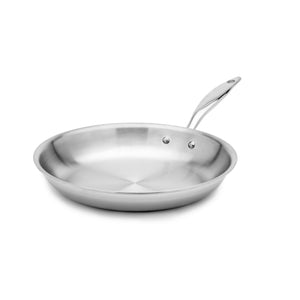
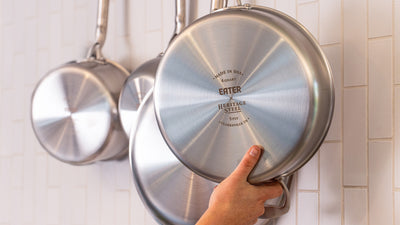
 Fig. 01 · Heritage Steel Titanium Series 316Ti stainless clad 12-inch fry pan
“Titanium cookware” has a nice ring to it. Titanium is the metal of jet engines, surgical implants, and mountain bikes — so a pan with a pure titanium cooking surface, wrapped around an aluminum core and a stainless exterior, sounds like the ultimate multi-clad. Space-age surface, proven core, best of everything.
The metallurgy tells a different story. A pure titanium cooking surface solves problems you don’t have and creates several you do. Here’s what actually happens when you put solid titanium against your food — and why a titanium-strengthened 316Ti stainless surface, like the one we’ve built in Clarksville since 2013, is the smarter piece of engineering.
Titanium doesn’t cook better — the core does
Start with the claim that titanium heats better. In a clad pan, it doesn’t matter. The cooking surface is a thin skin; virtually all of your pan’s heating behavior — evenness, responsiveness, how well it holds temperature when the steak hits — comes from the conductive core, not the surface layer. Titanium conducts heat a little better than stainless as a raw metal, but heat travels straight through a thin surface layer almost regardless of what it’s made of. Bolt a titanium skin onto an aluminum core and you get the same heating performance you’d get from a stainless skin on that same core.
So the headline benefit of a pure titanium surface — better heat — evaporates the moment it becomes one layer in a clad stack. You’re paying a premium for a property the construction makes irrelevant.

It’s not non-stick — and no better than stainless
Here’s the part the marketing rarely makes clear: bare titanium is not non-stick. It’s roughly on par with bare stainless steel — proteins like eggs and fish will grip either surface without enough fat and a proper preheat.1 Any titanium pan advertised as “non-stick” is relying on an added ceramic or PTFE coating for that release, not the titanium itself; strip the coating and you’re back to a bare-metal surface that behaves much like stainless.2
So a pure titanium cooking surface buys you no release advantage over the stainless you’d otherwise have — while a well-finished 316Ti surface gives you that same stainless behavior with no coating to scratch, flake, or wear out, and nothing between you and a lifetime of cooking.
The real flaw is in the bonding
This is the one that matters most, and it’s invisible from the sales page. Titanium is a nightmare to clad. It has a different rate of thermal expansion than aluminum and stainless, and it’s chemically reactive at the high temperatures used to bond cookware layers together — a combination that makes a durable metallurgical bond between titanium, aluminum, and stainless genuinely difficult to achieve and to keep.3
The mechanism is well documented. When titanium is bonded to steel or aluminum under heat, the metals interdiffuse and form brittle intermetallic compounds right at the joint — Ti–Fe against steel, Ti–Al against aluminum — and it’s the brittleness of that bond line that invites failure.45
Every time you heat and cool the pan, those mismatched layers expand and contract at different rates, stressing the bond line.6 The failure mode for a poorly bonded clad pan is delamination — the layers separating, warping, or blistering over years of use. A cooking surface is only as good as its attachment to the core underneath it, and pure titanium is the hardest surface in the business to attach well.
This is precisely why titanium’s virtues belong inside the alloy in a well-designed pan, not on top of it.

The smarter way to use titanium: put it in the steel
Our Titanium Series is built from a specialty stainless called 316Ti — the same 316 stainless prized for corrosion resistance, reinforced with titanium alloyed directly into the steel. That titanium isn’t sitting on the surface causing bonding headaches; it’s doing metallurgical work throughout the alloy — tying up carbon, protecting the chromium that fights corrosion, and helping the steel resist the salt pitting and staining that wear down lesser cookware. You get titanium’s genuine contribution — durability and corrosion resistance — in a material that also forms, welds, and bonds like the excellent stainless it is.
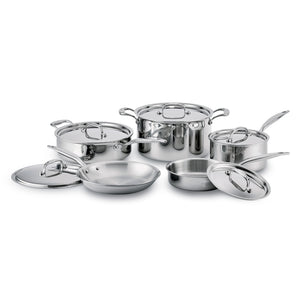
That means a 316Ti surface drops into a 5-ply fully clad stack with no compromise: a titanium-strengthened 316Ti cooking surface and mirror-polish exterior, wrapped around aluminum layers that do the actual heating. It bonds reliably, it won’t delaminate, and it heats evenly because the aluminum core — not a marketing surface — is doing the work. Every pan is 3 mm thick, oven and broiler safe, induction-ready, and made with no PFAS, no PTFE, no ceramic sol-gel, no nanoparticles, no coatings of any kind — just high-quality cladded steel.
Titanium’s inertness edge is real — and almost never matters
Titanium fans have one genuinely fair point, so let’s meet it head-on: pure titanium is highly inert, and it won’t leach nickel the way stainless can. That’s true. What the pitch leaves out is that it almost never matters in a real kitchen.
Peer-reviewed testing confirms stainless does release small amounts of nickel and chromium — most of all during long, acidic cooks — but the same research finds those amounts fall below allergy-triggering thresholds and deems 18/10 stainless cookware safe for the general population.7 The nickel you’d pick up from a normal meal is small next to what’s already in everyday foods like nuts, oats, chocolate, and shellfish, and it sits well under the tolerable daily intake regulators have set.8 The reactivity gap only becomes real in edge cases: hours-long acidic simmers, brand-new or damaged pans, or a diagnosed nickel sensitivity.
And the comparison the titanium pitch relies on is usually against basic stainless. Our 316Ti isn’t that. The molybdenum and titanium stabilization in 316Ti give it better resistance to corrosion and salt pitting than ordinary 304 — a tougher, more acid- and salt-resistant surface that stays non-reactive within every recognized safety limit. (Like all 316 stainless it still contains nickel and it isn’t titanium — but it releases only trace amounts, within those safe limits.)
So titanium’s inertness is a real edge on paper. It’s just a marginal, situational one — on a surface layer that’s thin either way — and it doesn’t come close to offsetting the trade-offs of putting solid titanium against your food: no release advantage, and a genuine bonding problem.
What you’re actually choosing between
| Consideration | Pure Titanium Surface | 316Ti Multi-Clad (Heritage Steel) |
|---|---|---|
| Heating performance | No real advantage — the core does the heating | Even, efficient heating from a real aluminum core |
| Sticking / release | Not non-stick — no better than bare stainless | Not non-stick, but no coating to fail; releases with proper technique |
| Bond durability | Brittle intermetallics + expansion mismatch → delamination risk | Reliable 5-ply bond that won’t separate |
| Food reactivity | Highly inert — a genuine edge, but negligible in normal cooking | Non-reactive within every recognized safety limit |
| Coatings | Often relies on ceramic/PTFE for release | None — no PFAS, PTFE, ceramic, or nanoparticles |
| Value | A premium for a buzzword | Lifetime warranty, made in USA, honest pricing |
One of these is engineered around what a pan actually needs. The other is engineered around what sounds impressive.
Built to outlive the trend
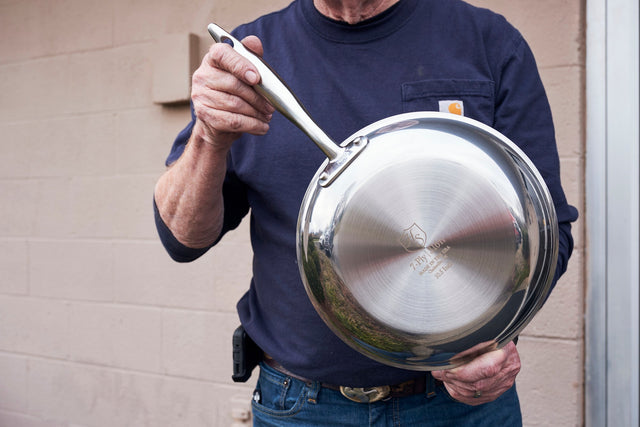
We’ve been making fully clad stainless cookware at our family-owned Clarksville, Tennessee factory for over 40 years, and we introduced 316Ti to our cookware in 2013 because it was the right material — not the flashiest name. Our customers routinely tell us their sets are still going strong after 30 years. That’s the whole point: cookware that’s honest about what makes it good, built to last a lifetime, and priced without the crazy markup that a buzzword surface invites.
If you want titanium in your cookware, you want it where it earns its keep — strengthening the steel, not sticking to your eggs.
Explore the Titanium Series — made in USA, 5-ply fully clad, lifetime warranty.
References
- Valtcan, “Solid Titanium vs. Titanium-Coated Cookware: What’s Actually Touching Your Food” — states that food sticks to bare titanium the same way it sticks to stainless steel.
- HonTitan, “Are Titanium Pans Safe? The Truth Behind the Label” (2026) — describes a raw titanium surface as closer to stainless steel, requiring the same fat-and-preheat technique; not non-stick in the PTFE sense.
- Clad Metals LLC, “Bonding of Dissimilar Metals,” U.S. Patent 6,427,904 — lists titanium among metals difficult to bond and notes that brittle intermetallic compounds can cause delamination in finished clad products, with cookware among the listed applications.
- “Method for Manufacture of Titanium Clad Steel Plate,” U.S. Patent 5,060,845 — a brittle Ti–Fe intermetallic compound forms by interdiffusion during titanium-to-steel cladding, making a sound joint extremely difficult to achieve.
- “Current Trends in Dissimilar Diffusion Bonding of Titanium Alloys to Stainless Steels, Aluminium and Magnesium,” Journal of Manufacturing and Materials Processing 4, no. 2 (2020), MDPI — dissimilar titanium joints form intermetallic compounds at the interface and are extremely difficult to join by fusion welding.
- “Bimetallic Welds: Fundamentals, Types and Applications,” Inspenet — differing coefficients of thermal expansion between dissimilar metals produce residual stresses and cracks at the joint.
- Kamerud, K. L., Hobbie, K. A., & Anderson, K. A., “Stainless Steel Leaches Nickel and Chromium into Foods During Cooking,” Journal of Agricultural and Food Chemistry 61, no. 39 (2013) — nickel and chromium migration rises with long, acidic cooks but remains generally below allergy-triggering thresholds; 18/10 stainless is considered safe for the majority of nickel- and chromium-sensitive individuals.
- “Is Stainless Steel Cookware Safe?” (2025) — reports a regulatory tolerable daily intake for nickel of roughly 13 µg per kg of body weight per day, substantially greater than the amount contributed by cooking.