


The 5 rules of good cookware
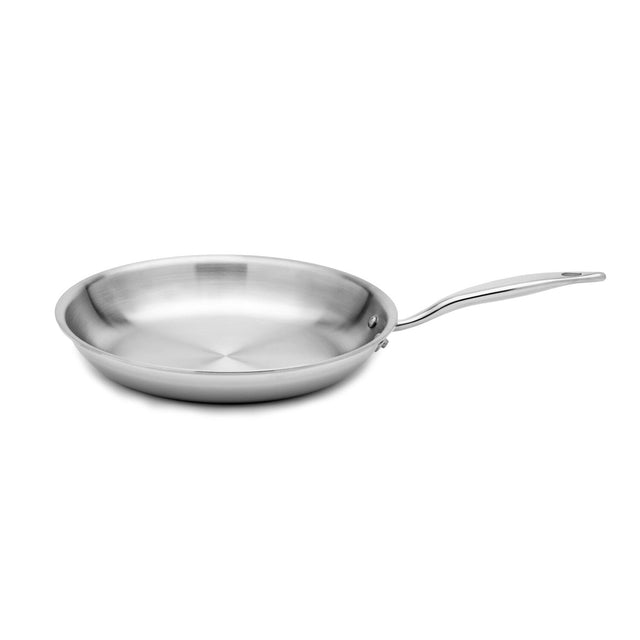
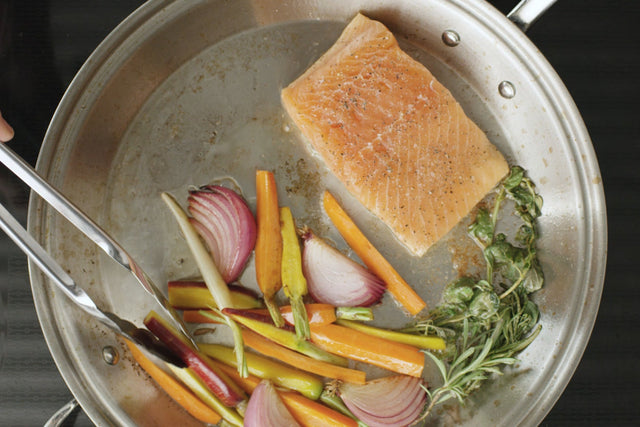
The ideal form of cookware combines even and efficient heating with chemical non-reactivity. Only multiclad stainless steel cookware truly meets all the requirements of good cookware.
 Fig. 01 · The 5 rules of good cookware
In On Food and Cooking, food scientist Harold McGee lays out what the ideal pan would be:
We generally want two basic properties in a utensil. Its surface should be chemically unreactive so that it won't change the taste or edibility of food. And it should conduct heat evenly and efficiently, so that local hot spots won't develop and burn the contents… [Multiclad stainless steel] hybrids are the closest thing we have to the ideal chemically inert but thermally responsive pan.
— Harold McGee, On Food and Cooking
Two attributes, then: even and efficient heating, and a surface that is chemically inert and durable. Here's how those two attributes turn into five rules — and why multiclad stainless steel is the construction that satisfies all of them.
Even & efficient heating
Cookware is made out of two basic types of materials:
Insulators such as glass, ceramics, or earthenware conduct heat very inefficiently because of their molecular structure. They can be used effectively in ovens but not on the stovetop.
Conductors are metals such as copper, aluminum, or cast iron that conduct heat much more efficiently, given the free flow of electrons in metals. However, not all conductors are equally efficient — heat flows significantly better in copper and aluminum than in cast iron, carbon steel, or pure stainless steel.
Thermal conductivity (Btu/hr·ft·°F):
| Copper | Aluminum | Cast Iron | Carbon Steel |
| 218 | 126 | 27.7 | 25.9 |
Rule #1: To heat efficiently, cookware must be made in large part from a good conductor — copper or aluminum.
Now let's compare evenness of heating in three different constructions.
1. Thick pan, low conductivity: cast iron & carbon steel
Because of the relatively low conductivity of cast iron and carbon steel, heat travels slowly through these pans. Combined with their thickness, this creates hot spots on the cooking surface that are unlikely to even out, because of the heat lost at the surface via radiation.
Heat climbs slowly from the burner
Hot spots form — the gaps never catch up
2. Thin pan, high conductivity: aluminum & thin multiclad
Heat travels much more quickly through aluminum than through cast iron or carbon steel. But when a highly conductive metal is used in only a relatively thin layer, it can still create hot spots — along with other problems in cooking performance.
Heat races through thin aluminum
Fast — but it still spikes over each flame
3. Thick pan, high conductivity: quality multiclad stainless
When there is a thicker layer of aluminum for heat to travel through, it has the chance to distribute itself evenly — creating a cooking surface with little to no heat differential.
A thick aluminum core carries heat up and outward
Almost perfectly even, edge to edge
Rule #2: To heat evenly, the body of the cookware must be both sufficiently conductive and thick.
Pan thickness
Thicker isn't always better. There is a tradeoff between heat retention and responsiveness: thicker pans hold more heat, which is what you want for searing and sautéing. Thinner pans adjust more quickly to temperature changes — like bringing a sauce from a boil down to a simmer.
Fry pans, skillets, and sauté pans should be thicker, for heat retention. Saucepans and other pans intended mostly for liquid-based cooking should be thinner, for responsiveness.
Rule #3: A pan's thickness should match its intended use — heat retention or heat responsiveness.
Chemically inert & durable
No single material is both highly conductive and chemically inert:
A material whose electrons are mobile enough to conduct heat well is also likely to give up those electrons to other atoms at its surface: in other words, good conductors like metals are usually chemically reactive. By the same token, inert compounds are poor conductors.
— Harold McGee, On Food and Cooking
How different metals react
Aluminum is highly reactive with acidic foods, which can alter the food's flavor and color. The pan can also degrade, leaving a pitted surface — or dent and warp.
Copper ions can easily leach into foods, which build up in the body and can lead to health issues. It also suffers from general corrosion, and will tarnish and lose its luster without consistent polishing.
Cast iron & carbon steel will leach iron into your food, potentially affecting its flavor — especially with acidic ingredients. Rusting will also occur unless the cookware is thoroughly dried after each use.
Acidic sauce meets a reactive metal
Ions drift into the food — the surface pits
Stainless: the oxide layer keeps metal in the pan
Rule #4: Cookware should not be made purely from a conductor — it will chemically interact with food and its environment.
Material combinations
To solve the conductivity-versus-reactivity problem, many types of cookware combine materials: a conductive core with a non-reactive surface. But most of these combinations suffer from drawbacks in durability:
- Non-stick pans cover conductive materials with coatings that don't react with food — but degrade at high temperatures and are prone to scratching and chipping.
- Enameled cast iron uses a thin ceramic layer that can chip, scratch, or crack, exposing the cast iron beneath and leaving an uneven cooking surface.
- Anodized aluminum builds a non-reactive oxidized layer — which your dishwasher and certain cleaning agents will stain and degrade.
Clad stainless steel
Clad stainless is the construction that solves these problems. By sandwiching an aluminum interior between layers of stainless steel, you combine the conductivity of aluminum with the non-reactivity and durability of stainless.
Stainless steel is uniquely well-suited to the job. Its high chromium content naturally forms a thick oxide layer that prevents rust and chemical interaction with food — while providing an attractive shine. And it is uniquely durable, offering a lifetime of reliability.
Wondering whether the nickel in stainless steel is something to worry about? We dig into that in Why we don't make nickel-free cookware.
Rule #5: Cookware should be designed for both functionality and durability.
Why value durability?
We believe the lifespan of cookware should be measured in decades, not months or years. A pan should perform the same as the day you bought it — not force a replacement once it corrodes, cracks, or scratches.
Cheap cookware becomes much more expensive when you have to replace it on a regular basis.
- Heat efficiently: build with a good conductor — copper or aluminum.
- Heat evenly: the body must be both conductive and thick.
- Match thickness to use: retention for searing, responsiveness for sauces.
- Stay inert: the cooking surface must not react with food.
- Build to last: functionality and durability, together.
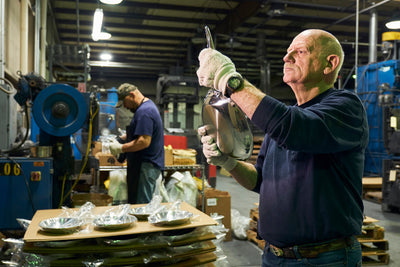
Want to see these rules turned into metal? Watch the blanks become pans in How a pan is built.