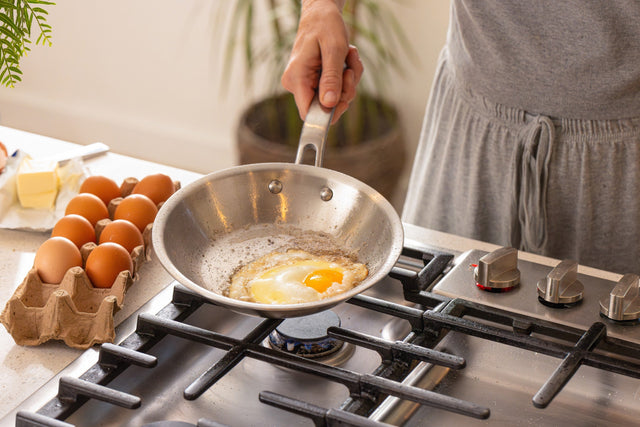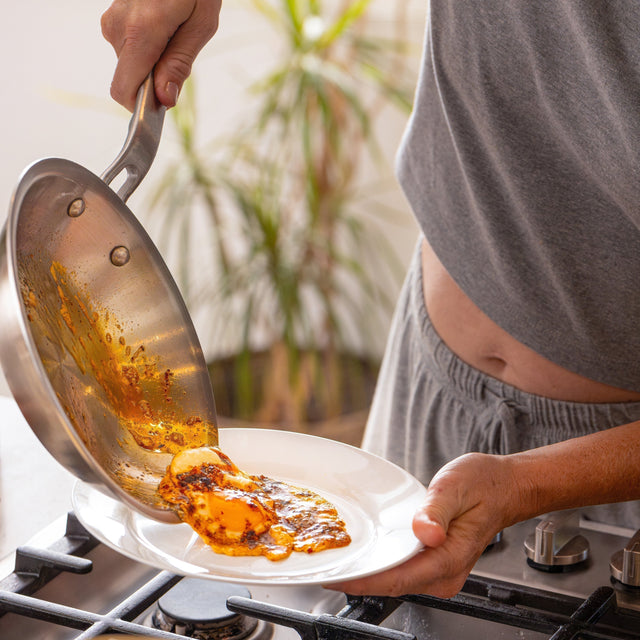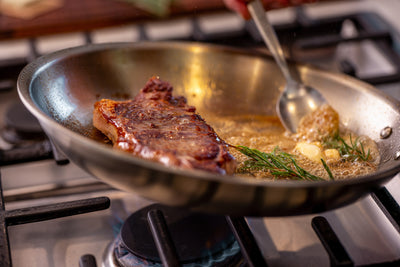



The basic techniques, visualized
Temperature control is the whole game. See how your pan will react and why.
 Fig. 01 · The basic techniques, visualized
Cooking with stainless steel comes with a learning curve — and delivers results other cookware can't match. There's no coating doing the work for you, which means a little technique goes a long way. Nearly all of it comes down to one thing: temperature control.
The basics
A stainless cooking surface is microscopically porous. As the pan heats, the metal expands and those pores shrink; add food at the wrong moment and they grip it. Manage the heat and the same surface releases food cleanly — no coating required.
As the pan heats, the pores contract
As the pan cools, the pores widen
- Preheat properly, on low to medium heat, and confirm with the water droplet test — when drops bead and skate, the pan is ready.
- Add your cooking oil after preheating and let it come up to temperature — it's your buffer against the shock of cold food. Shimmering, but not smoking.
- Let food come near room temperature before it hits the pan — the smaller the temperature swing, the less the surface grips.
- Don't overcrowd the pan — every cold addition drops the temperature, and a crowded pan can't recover.
- Wait for the release — food lets go on its own when it's ready. If it fights the flip, give it another minute.
Keeping the pan at a fairly consistent temperature is what prevents sticking while you sauté and sear. Big cold additions and wild heat swings are what get people in trouble — not the steel.
Wait before flipping
With larger proteins — chicken, fish, steak — patience is the technique. Cold food temporarily drops the pan's surface temperature, the pores widen, and they grip the meat as the heat recovers. Once the pan comes fully back to temperature, it pinches off the small bits it was holding and the food releases on its own. If it fights you when you go to flip, it isn't ready. Give it a few more seconds and try again.
Tempering your food helps here too. Let it come up toward room temperature before it ever touches the pan — pull a steak from the fridge thirty minutes or so before you plan to cook it. The smaller the temperature swing when it hits the surface, the less the pan grips — and the more evenly it cooks from edge to center.
Start with a hot, preheated pan
Adding food drops the temperature
While the pan reheats, it will grip the food
Once back to temperature, the food will release
Now flip!
Fat is a buffer
That thin layer of oil you add after preheating does more than keep things from sticking to the surface. The fat heats up to the pan's temperature — and when food lands, the fat takes the first hit. It's a heated buffer between cold food and hot steel, softening the temperature drop that causes gripping in the first place.
The levers all work together: more fat means more buffer. But the better you temper your food — and the less you crowd the pan with cold mass — the smaller the shock, and the less fat you need to absorb it. Crowding works against you the same way tempering works for you: every cold thing you add is another hit, and a packed pan never gets the chance to climb back to temperature.
Add fat to the preheated pan
The fat heats to the pan's temperature
When food lands, the fat absorbs the shock
The pan barely cools — and barely grips
Sear, deglaze, reduce
Those browned bits left in the pan after a sear are called fond, and they're not a mess — they're the flavor base for pan sauces and braises. Stainless steel's slight porousness is exactly what makes fond possible; a nonstick surface physically can't build it. And because the steel is non-reactive, you can deglaze with wine, tomato, citrus — any acid a sauce calls for — without the pan pushing back.
Fond is built up on the pan from searing
Add a liquid to deglaze, such as white wine
Scrape and incorporate the fond into the liquid
Voila! A beautiful pan sauce
Want the guided version? This article opens our Cooking Fundamentals track — and for the physics underneath all of it, read The grand theory of sticking.