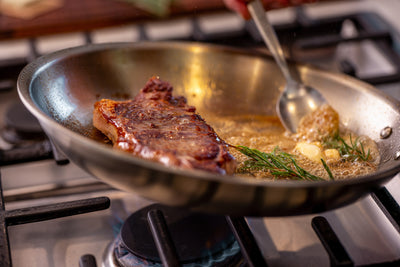



The grand theory of sticking — and how to prevent it
How to build stability in your pan's surface (and prevent its disruption).
 Fig. 01 · The grand theory of sticking — and how to prevent it
Here is the claim this whole piece rests on:
A stainless steel cooking surface has a stable state and an unstable state. In the stable state, food releases. In the unstable state, food bonds to the metal. Every technique you've ever been told — preheat the pan, dry the fish, temper the steak, don't crowd, use enough fat — is a move in one single game, which is keeping the surface stable.
Once you see it that way, the advice stops being a list of superstitions you have to memorize and becomes a budget you can spend. Some things you do cost stability. Other things buy it back. A good cook is considering that balance continuously, mostly without thinking about it. The goal of this piece is to make that push and pull easier to understand.
What stability means
Part one · What creates instability
Part two · What reinforces stability
Part three · Running the ledger
What stability means
Sticking isn't food getting physically caught on a rough surface. It's food chemically bonding to the metal — real bonds forming between proteins in the food and metal atoms in the pan. That's why sticking is overwhelmingly a protein problem, and it's why the fix has to do with temperature rather than with scrubbing your pan smoother.
Two things have to be true at once for those bonds to form. The food has to be hot enough that its proteins have come apart and exposed their sticky parts. And the food has to still be wet where it touches the pan, because that's what keeps it pressed against the metal long enough to bond.
Which gives us a band:
Below about 140°F. Proteins are still folded up. Their sticky parts are tucked away inside. Not much happens.
Roughly 160°F to 300°F — the unstable band. Proteins have come apart and their sticky parts are exposed. And there's still liquid water at the surface, which holds the whole interface at 212°F no matter how hot the metal underneath is, because every bit of heat arriving goes into boiling that water instead of raising the temperature. The contact point gets parked right in the middle of the danger zone and stays there. Maximum bonding time.
Above about 300°F. The water is gone. The contact layer dries out, browns, and sets into a crust that holds together better than it holds onto the pan. It releases.
A stable surface is one where the contact point either stays out of that band or crosses it fast. An unstable surface is one that gets parked in the middle of it.
Wet food gets clamped at 212°F — parked in the band
Dry food, hot pan — across the band fast, then release
The reason it parks at exactly 212°F: that's where water boils, and as long as liquid water remains at the contact point, every bit of arriving heat is spent boiling it off instead of raising the temperature. The surface physically can't pass 212°F until the water is gone — so wet food isn't just in the band, it's held there for as long as it stays wet.
This reinforces an important fact: sticking is temporary. The fish that's welded to the pan at ninety seconds lifts freely at four minutes. When you wait, you're not out-muscling anything — the bond genuinely weakens as the crust forms and the contact point climbs out of the band. Tearing it early means fighting a problem that was about to solve itself.
It also explains why a splash of wine lifts everything off instantly, and why eggs misbehave at temperatures where a ribeye is perfectly polite.
So basically there are two lists: things that push the contact point into the unstable band and hold it there, and things that push it through (or keep food and metal from touching at all).
Part OneWhat creates instability
Moisture: the one nobody takes seriously enough
Water is the biggest destabilizer by a wide margin, and the reason is that boiling water off takes an enormous amount of heat — far more than simply warming it does.
Here's the scale of it. Evaporating a teaspoon of surface moisture off a piece of fish — barely enough to notice when you pick it up — pulls roughly 50°F off the cooking surface of a 12-inch pan, instantly, right where the food is sitting.
And it's worse than a simple temperature drop, because of how that heat leaves. As long as there's water boiling at the contact point, that point is held at 212°F. Wet food doesn't just cool your pan. It clamps the interface in the middle of the unstable band for the entire time it takes to dry out, which is exactly the window when bonding happens.
Patting food dry outranks every other prep step on this list. It is the highest-leverage thirty seconds in the whole process. For anything where you want browning or a sear, use some paper towels to dab away moisture on the food before it hits the pan. It has a big payoff!
How much food, and how cold
A six-ounce chicken breast straight from the fridge needs more heat to cook through than the entire base of your pan is holding in reserve. The burner makes up the difference over the next several minutes — but the pan has to cover the opening moment alone.
Letting food sit out first helps in two ways. The obvious one: a chicken breast that warms from 38°F to 55°F on the counter needs about 13% less heat from your stove to cook through. Your kitchen paid that part of the bill instead of your burner. Real, but modest.
The bigger effect is about where that warmth ends up. The outside of a piece of food warms up much faster than the middle does, and it's the outside that determines how hard the opening moment hits. Thirty minutes on the counter may barely move the center of a thick chicken breast — and that's fine. It doesn't need to. You just need the face that's about to meet the pan to not be refrigerator-cold.
Crowding is the same principle wearing a different costume. Four pieces of chicken don't ask for four times the heat spread evenly across the surface. They ask for it all at once, in four separate cold spots, from a pan that can only move heat sideways so fast.
What the food is made of
Some foods are chemically primed to bond with stainless steel.
Eggs are the hardest case in the kitchen. There's a nice irony to it: one of the main proteins in egg white exists specifically to grab onto iron — it's an antimicrobial defense, locking up iron so bacteria can't use it. You're cooking a protein evolved to bind metal, directly on metal. Treat eggs as the maximum-difficulty case and give them every advantage you have. (For the method-by-method version, see how to cook eggs in stainless steel.)
Lean, wet proteins — fish, scallops, skinless chicken breast, tofu. No fat to baste themselves with, lots of moisture to hold the contact point at 212°F, and delicate enough that when you pull, the food tears before the bond does.
Starches — potatoes, rice, anything dredged in flour. Cooked starch is paste. That isn't a figure of speech; it's been used as glue for centuries.
Sugars — glazes, teriyaki, tomato paste, onions, anything with honey in it. Browning sugars turn sticky and flow into the surface before they set.
And the forgiving ones — bacon, skin-on chicken, well-marbled steak, 80/20 ground beef. Not easier because they have less protein, but because they bring their own fat. They stabilize themselves.
Your stovetop
No burner heats perfectly evenly. Gas lays down a ring of flame. Electric coils trace a spiral. Induction energizes a ring matching the coil underneath. Meanwhile heat is constantly leaving at the rim — radiating away, and conducting out through the handle — so the outer edge always runs cooler than the center.
Good cookware narrows those gaps. That's most of what a conductive core is for. But nothing erases them, and understanding where a cold zone might exist on your pan helps you avoid issues in dealing with it.
Worth mapping your own: heat the pan dry, dust it with flour, and watch where the browning starts. Put whatever's most at risk over the strongest part of the surface. And keep in mind that on a 12-inch pan, only about 9.5 inches of it is actually flat.
Part TwoWhat reinforces stability
Fat, and why a very thin layer is enough
Oil does three separate jobs here, and the most important one is the least obvious.
It coats the metal at the molecular level. Oil molecules have a shape that matters: one end is chemically attracted to metal, and the other end is a long greasy tail that isn't attracted to much of anything. Put oil on a hot pan and those molecules line up — grabby ends down against the steel, slick ends facing up. What the food lands on isn't really metal anymore. It's a layer of tails.
Oil molecules have a grabby end — and a long slick tail
On hot steel they line up — grabby ends down, tails up
Food lands on the tails, not the metal
The practical consequence is the useful part: coverage matters more than volume. A thin film that has properly spread and grabbed the surface beats a generous puddle poured into a cold pan, because the puddle hasn't done that. It's also why hot pan, then oil, then food is the right order — you want the oil to spread and take hold, not sit there.
It fills the texture. A polished pan isn't smooth at the scale that matters; there are peaks and valleys, and soft food flows into them and locks in. Oil floods those valleys. It also pushes out the air trapped in them, and air is a terrible conductor of heat — those little pockets are insulating dead spots. An oiled pan transfers heat more evenly than a dry one, at exactly the scale where it counts.
It's thermal mass sitting on top of the pan. More fat means more buffer between the burner and the food. Deep frying is the extreme case: at that ratio the food never really touches metal, and sticking stops being a category of problem. Everything between a slick and a fryer is a point on that same line.
Mass and cladding in the pan itself
Here's the honest version of the thick-pan argument, because the usual version overreaches.
A heavy clad pan does not hold enough stored heat to absorb a cold chicken breast. Nothing does. The burner does most of that work over the following minutes.
What mass actually buys you is the first ten seconds. When cold food lands, the surface right underneath it drops before heat can flow in sideways from the surrounding metal. That dip is exactly when unstable-band bonding happens. A thick, fully clad base makes it shallower and shorter — not by storing more heat overall, but by refilling the cold spot faster.
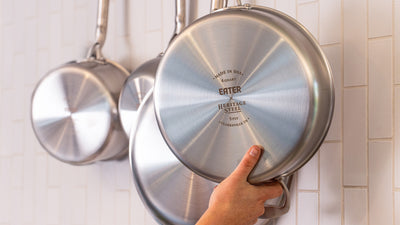
This is exactly why we build our fry pans and skillets at 3.0mm — noticeably thicker than a lot of what's out there, and thicker than we'd need to make them if we only cared about durability. Frying is where sticking lives: dry heat, protein going straight onto metal, nothing in between. Boiling isn't — water holds the whole system at 212°F and nothing sticks to anything. So we put the mass where the instability is.
It's also why the whole body is clad rather than just a disc welded to the bottom. The cold spot under your food doesn't only get refilled from below; it gets refilled from the sides, by the metal around it. A pan that stops conducting where the base ends has less to draw on.
Part ThreeRunning the ledger
You have a budget now, not a rulebook.
Something wet, cold, lean, and delicate — a fillet of fish straight from the fridge — spends nearly all your stability at once. So you buy it back everywhere you can: dry the surface, let it come up in temperature, preheat properly, use enough fat, put it over the strongest part of the pan, don't crowd it. Then leave it alone until the crust decides to let go.
Something forgiving — a well-marbled steak at room temperature, patted dry — arrives with slack in the budget. You can crowd it a little. You can move it early. It's paying its own way.
And when something does go wrong, the question stops being "what did I do wrong?" and becomes "where did the instability come from?" Wet surface. Cold center. Too much food at once. Cold spot on the burner. Not enough fat, or fat added to a cold pan. Each has a different fix, and now you know which one to reach for.
Calibrating the pan
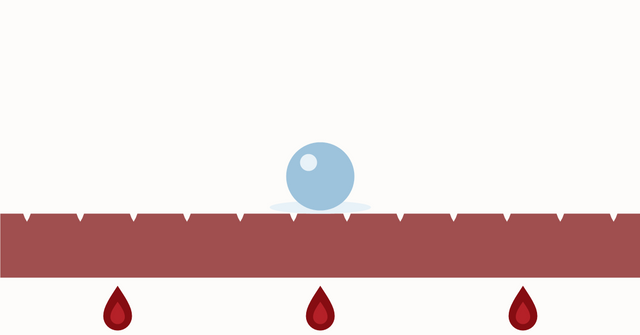
The water drop test works: flick a few drops onto the dry, preheated surface. Below boiling they sit and slowly disappear. Just above it, they hiss and vanish. Hot enough, and they pull together into beads that skate across the pan, riding on their own cushion of steam.
One caveat, because this test gets oversold: the temperature where that happens reliably is around 400–430°F, which is hotter than you'll actually cook most things and above the smoke point of several common oils. It's a calibration reference — it tells you your pan and your burner setting have arrived. It doesn't mean you should sear salmon at 430°F.
Stainless steel isn't difficult. It's uninsulated. It hands you the raw physics with nothing in between. A coated pan makes these decisions for you by refusing to participate in the chemistry at all. Stainless makes you participate — and in exchange gives you fond, and browning, and a pan that will outlive anything with a coating on it.
Stability is the whole game. Everything else is bookkeeping.
Sources: Why pans stick (Royal Society of Chemistry) · Protein unfolding and steel fouling (Food and Bioproducts Processing) · Iron-binding proteins in egg white (Foods) · Fatty acid monolayers on stainless steel (Langmuir) · Leidenfrost effect in cooking (arXiv)
Temperature and energy figures are our own estimates from published material properties, not lab measurements.