


The water droplet test: when to use it (and when not to)
A tiny flick of water tells you when a stainless pan is sear-ready. How to read it, why it works — and why half of what you see online gets it wrong.
 Fig. 01 · Diagram of a water droplet gliding on a hot stainless pan
The water droplet test — flick a little water into a preheating pan and watch what it does — is the quickest way to know when a stainless pan has serious heat. No thermometer, no guesswork. It's genuinely useful. It's also overused — and a lot of what you'll see on social media gets it wrong. Here's how to do it right, and just as important, when not to bother.
How to do it
- Preheat the empty, dry pan over low to medium heat. Give it a couple of minutes.
- Wet your hand and flick a few drops on. You don't need a whole lot.
- Read the result. If the water sits there or lazily bubbles away, keep waiting. When it pulls into a bead and dances across the surface, the pan is ready.
- Get the water out — with that little, you can just tip it out of the pan (a quick pass with a towel works too). Then, and only then, add your oil.
What the dancing means
That skating bead is the Leidenfrost effect: the pan is hot enough that the bottom of the droplet vaporizes instantly, and the drop rides around on a cushion of its own steam instead of boiling away against the metal.
The textbook threshold is around 380°F, and a confidently dancing bead usually means you're into the 400s — deep searing territory. Treat it as a floor rather than a precise reading; you'll sometimes catch beads skating a little before the textbook number. Either way, a dancing bead means the pan is seriously hot.
One more reading, at the far end: if the drop shatters instantly into a swarm of tiny skittering beads that vanish, you've overshot. The test is better at saying “ready” than “too hot” — but if you see confetti, pull the pan off the heat for a minute and let it settle.
Not hot enough — the drop just sits and bubbles
Getting closer — it sputters away
Ready — the bead glides on a cushion of its own steam
Too hot — it shatters into skittering beads
▶ Watch the real thing — 30 seconds, on a real pan
What people get wrong
Two habits from the internet worth un-learning:
Too much water. Pouring in a splash — or a cupful — and waiting for it to bead up demands a blazing-hot pan, and mostly it just makes steam. The test works because the amount is tiny. Wet your hand, one flick. That's it.
Adding oil while the water is still dancing. Very hot oil and water are a bad combination: it sputters, it spits, and it can burn you. The water leaves first — every time — and then the oil goes in.
When to use it
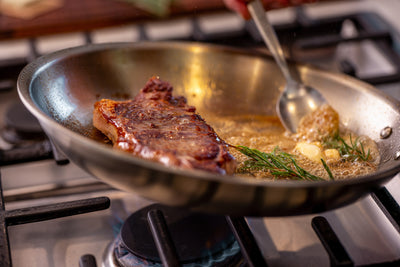
The droplet test answers exactly one question: is this pan hot enough to sear? So use it when searing is the job — steak, chicken breasts and thighs, chops, anything you want a hard crust on. Dancing bead, water out, oil in, food on.
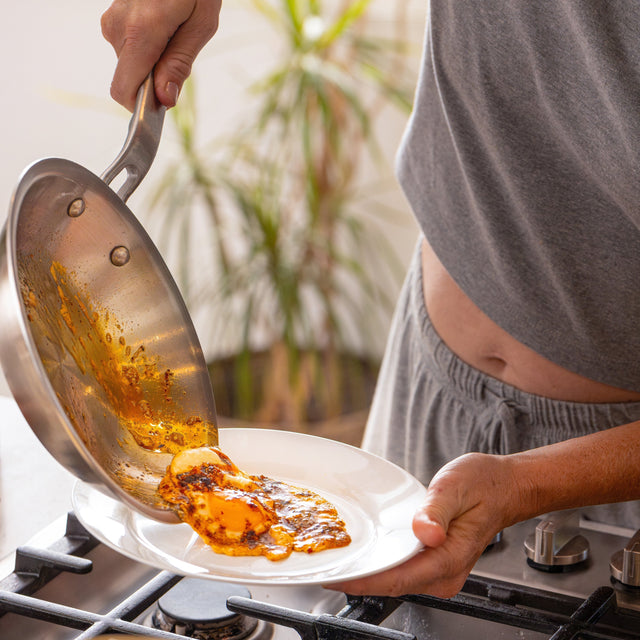
It isn't just meat, either. If you like scrambled eggs cooked fast, a water-test pan is exactly what you want — all that stored heat cooks the eggs quickly instead of letting them sit and tighten up.
Three notes for that moment: reach for a high smoke-point oil — avocado, canola, grapeseed — rather than olive oil, which smokes right around these temperatures. Don't dawdle: the pan is ready now. And sear temperature is for starting, not finishing — once the crust is set, turn the heat down and let the pan coast.
When to skip it
Most cooking isn't searing — and most cooking doesn't need this much heat.
Anything water-based. Boiling pasta, simmering a sauce, building a soup: once there's water in the pan, preheating is beside the point. Fill it and turn on the heat.
Everyday sautéing. Onions for a soup, garlic for a sauce, a pile of vegetables: these are forgiving jobs. Food like that barely sticks no matter what you do, and it neither needs nor wants sear-level heat. Honestly, you can start aromatics in a cold pan and nothing bad happens. Oil that shimmers is all the signal you need.
Frying an egg. Maybe controversial, but: a water-test pan is far too hot for a fried egg. Fried eggs want gentle heat, and they want butter — and butter hitting a 400-degree pan browns and burns on contact. Skip the test entirely. Put the butter in over medium-low and watch it: when it melts and bubbles happily — not browning, not smoking — the pan is exactly where the egg wants it. (A fast scramble is the exception — see above.)
- Water dances — searing. Steak, chops, chicken with a crust — or a fast scramble.
- Oil shimmers — sautéing. Aromatics, vegetables, everyday cooking.
- Butter bubbles happily — fried eggs and delicate work. Gentle heat, no browning.
The droplet test is one cue among several — the loudest one, not the universal one. For the bigger picture, start with the fundamentals; and for the deeper story of why anything sticks at all, see A Grand Theory of Sticking.